Where the texts come from, and how this edition is made.
Every original text here can be traced to a page of Founders Online and to the dated copy we read. This page explains the sources, the checks for completeness, what was left out, and how the notes and modern texts are written.
Founders Online, read through the Wayback Machine
Every original text in this edition is a transcription published on Founders Online (opens in a new tab), the National Archives’ website for the papers of the founding generation. The transcriptions come from two documentary editions:
- The Papers of Thomas Jefferson: 328 letters
- The Adams Papers: 7 letters
When a letter is printed in both editions, we use the Jefferson Papers text and list the other printing as a second witness on the letter’s page.
When the corpus was built in November 2026, Founders Online was returning server errors. We therefore read every page from the Internet Archive’s Wayback Machine (opens in a new tab), which keeps dated copies of the site (the copies we used were made between February 2, 2025 and November 12, 2026). The pages were fetched with the Aside browser. Each letter’s page links both the Founders Online permalink and the dated snapshot we read, so every text can be checked against its source.
The text keeps the editors’ transcription as printed: the writers’ spelling, capitals and punctuation, their underlining and superscripts, words they struck out (shown struck through), and words the editors supplied [in brackets]. The editors’ own annotations are not reproduced.
Checked against Cappon’s 1959 edition
We compared our list with the standard edition of the correspondence, Lester J. Cappon’s The Adams-Jefferson Letters (University of North Carolina Press, 1959). Leaving aside letters to and from Abigail Adams, Cappon prints 329 letters between the two men, including some written jointly with or to colleagues such as Benjamin Franklin. Every one of them is matched to a letter in this edition except two whose texts are not online:
John Adams to Benjamin Franklin and Thomas Jefferson, 20 June 1785 (second letter of that day)
A short acknowledgment of the commissioners' letter of 15 June about a payment to John Baptist Pecquet. The modern Jefferson Papers describe it but do not print it; Cappon's 1959 edition prints it. The manuscript is in the Papers of the Continental Congress at the National Archives.
founders.archives.gov (opens in a new tab) · catdir.loc.gov (opens in a new tab)
John Adams to Thomas Jefferson, The Hague, 17 March 1788
A brief covering note asking Jefferson to pay an enclosed account, a Dutch coach-hire bill for 11–14 March 1788, from the days the two men spent together arranging a Dutch loan. Cappon's 1959 edition prints it; the modern Papers of John Adams lists it among omitted documents. The manuscript is in the Coolidge Collection at the Massachusetts Historical Society.
masshist.org (opens in a new tab) · masshist.org (opens in a new tab)
One short note, Jefferson’s of April 8, 1791, is printed only inside an editors’ footnote in The Papers of Thomas Jefferson. We added it by hand from that footnote and checked its wording against the State Department’s file copy at the National Archives.
The edition also includes a few short notes that do not appear in Cappon’s table of contents, among them the rhymed apology of March 1786.
Documents we found but did not include
Letters to and from Abigail Adams are outside the scope of this edition; the postscripts she added to her husband’s letters stay with those letters. We also left out the following documents, each for the reason given:
| Date | Document | Why it is not here |
|---|---|---|
| August 21, 1777 | To John Adams from Thomas Jefferson, 21 August 1777 (opens in a new tab) | Editorial summary only: the edition describes the letter but does not print its text. |
| December 17, 1777 | To John Adams from Thomas Jefferson, 17 December 1777 (opens in a new tab) | Editorial summary only: the edition describes the letter but does not print its text. |
| June 23, 1783 | To Thomas Jefferson from John Adams, 23 June 1783 (opens in a new tab) | Editorial summary only: the edition describes the letter but does not print its text. |
| October 17, 1784 | Thomas Jefferson to Franklin and John Adams: Résumé, 17 October 1784 (opens in a new tab) | Editorial résumé in the Franklin Papers; the letter itself is included from the Jefferson Papers. |
| November 10, 1784 | Thomas Jefferson to Franklin and John Adams: Two Memoranda, [before 10 November 1784 (opens in a new tab) | Commissioners' working memoranda with an editorial headnote, not a letter. |
| March 1, 1785 | Thomas Jefferson to Franklin and John Adams: Résumé, 1 March 1785 (opens in a new tab) | Editorial résumé in the Franklin Papers; the letter itself is included from the Jefferson Papers. |
| June 20, 1785 | John Adams to Franklin and Jefferson, 20 June 1785 (opens in a new tab) | Editorial summary only: the edition describes the letter but does not print its text. |
| October 10, 1785 | To Thomas Jefferson from John Adams, 10 October 1785 (opens in a new tab) | Editorial summary only: the edition describes the letter but does not print its text. |
| December 6, 1787 | To Thomas Jefferson from John Adams, 6 December 1787 (opens in a new tab) | Editorial summary only: the edition describes the letter but does not print its text. |
| May 24, 1797 | To John Adams from Thomas Jefferson, 24 May 1797 (opens in a new tab) | The Senate's formal reply to the President's speech, signed by Jefferson as President of the Senate; an official address, not a letter between the two men. |
| October 12, 1824 | To Thomas Jefferson from John Adams, 12 October 1824 (opens in a new tab) | Written by John Adams of Richmond (a city official), not John Adams of Quincy. |
| October 18, 1824 | From Thomas Jefferson to John Adams, 18 October 1824 (opens in a new tab) | Addressed to John Adams of Richmond (a city official), not John Adams of Quincy. |
Letters known to be lost
This release lists no letters as lost. Letters that the editions describe but do not print are listed above, among the documents we left out.
Researched, sourced, and in our own words
The notes explain what a thoughtful modern reader would miss: events and controversies the writers allude to, people other than the most famous, books and quotations, ideas and terms of the day, words used in an old sense, places, sums of money, and references to other letters in this correspondence.
Each note is checked against reliable sources and lists the sources it relies on, with links. The notes are written in our own words. The print editions’ annotations served only as leads, and an automatic check rejects any note that shares eight or more consecutive words with them.
In the original view every note is numbered in reading order. A note that explains an old word the modern text no longer uses appears only beside the original.
A plain modern rendering that keeps every idea
The modern text is written in a “clarity” style: plain words in natural order, long sentences split where the logic allows, old words replaced by current ones, every idea, name, number and courtesy kept, and nothing added. It keeps each writer’s voice: Adams blunt, quick, learned and funny; Jefferson measured, balanced and elegant.
The modern text follows the original block for block, so on a wide screen the two can be read side by side. Spelling, punctuation and abbreviations are modernized; amounts of money, names and dates are kept. The original is always one click away, and where the two differ in a way that matters, the original is the authority.
Drafted by AI agents, checked letter by letter
The notes and modern texts are drafted by AI agents, one letter at a time, under written style guides. Automatic checks test each letter’s structure, completeness, length and note sources. A separate reviewing agent then reads each letter for errors of meaning, omissions, additions and factual mistakes; a letter that fails is repaired and checked again. Every letter page states whether its review is complete.
At present 335 of the 335 letters have a modern text and notes, and 28 have passed review. The others show the original transcription while their modern edition is prepared.
These are reading aids, not a scholarly edition. For research, quote and cite the original transcription and the printed volumes of The Papers of Thomas Jefferson and The Adams Papers.
How to cite
To cite the text of a letter, cite the documentary edition through Founders Online:
Thomas Jefferson to John Adams, 16 May 1777. Founders Online, National Archives, https://founders.archives.gov/documents/Jefferson/01-02-02-0016.
To cite our modern text or notes, cite this edition and the letter’s page:
The Jefferson–Adams Letters, “Thomas Jefferson to John Adams, May 16, 1777,” modern text and notes, https://jefferson-adams-letters.pages.dev/letters/1777-05-16-jefferson-to-adams/ (accessed [date]).
Every letter page ends with a ready-made citation for that letter.
Image credits
All images are public-domain works reproduced from Wikimedia Commons. Generated images are not used.
John Adams
Gilbert Stuart, c. 1800–1815. National Gallery of Art, Washington, D.C. (1954.7.1).
Public domain (CC0 1.0 Universal Public Domain Dedication, cc-zero; National Gallery of Art Open Access). Source (opens in a new tab)
Thomas Jefferson
Rembrandt Peale, 1800. The White House, Washington, D.C. (1962.395.1).
Public domain (PD-Art, PD-old-100-expired). Source (opens in a new tab)
John Adams
John Trumbull, 1793. National Portrait Gallery, Smithsonian Institution, Washington, D.C. (NPG.75.52).
Public domain (CC0 1.0 Universal Public Domain Dedication, cc-zero; released by the National Portrait Gallery). Source (opens in a new tab)
Thomas Jefferson
Mather Brown, 1786. National Portrait Gallery, Smithsonian Institution, Washington, D.C. (NPG.99.66).
Public domain (PD-Art, PD-old-100-expired). Source (opens in a new tab)
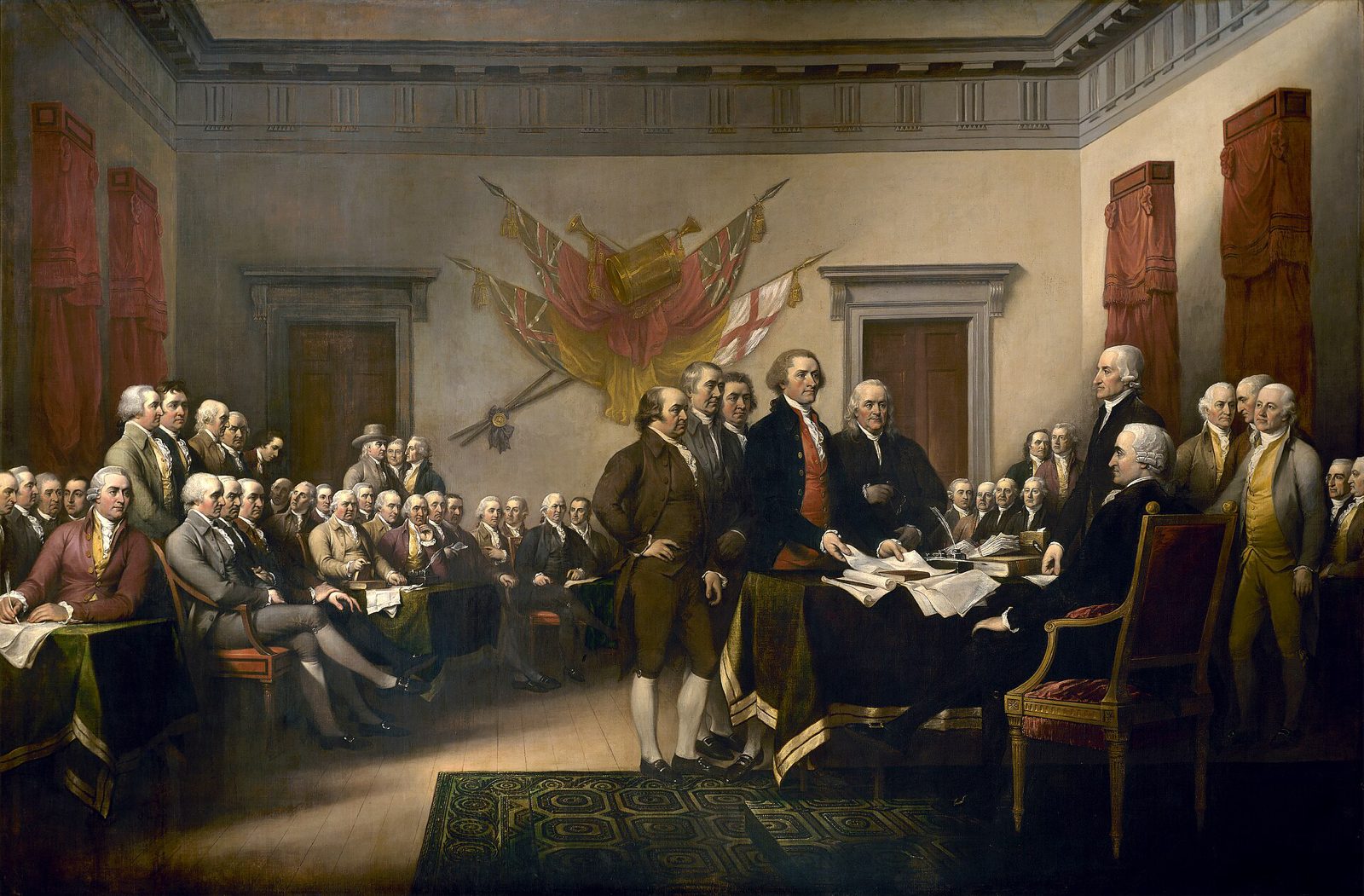
Declaration of Independence
John Trumbull, 1819. United States Capitol, Washington, D.C. (Rotunda).
Public domain (PD-Art, PD-old-100-expired). Source (opens in a new tab)
Le Pont-Neuf et la Pompe de la Samaritaine, vus du quai de la Mégisserie
Nicolas-Jean-Baptiste Raguenet, 1777. Musée Carnavalet – Histoire de Paris (P269).
Public domain (PD-Art, PD-old-auto-expired; Paris Musées also released the reproduction under CC0). Source (opens in a new tab)
This View of Grosvenor Square
Robert Pollard (engraver) and Robert Dodd (aquatint), after a drawing by Edward Dayes, 1789. Yale Center for British Art, New Haven (B1977.14.16783).
Public domain (CC0 1.0 Universal Public Domain Dedication, cc-zero; Yale Center for British Art Open Access). Source (opens in a new tab)
View of the West Front of Monticello and Garden
Jane Braddick Peticolas, 1825. Thomas Jefferson Foundation, Monticello.
Public domain (PD-Art, PD-old-auto-expired). Source (opens in a new tab)
Residence of ex-President Adams
Alexander Anderson (wood engraver), after a drawing by William Croome, 1830. The New York Public Library, Miriam and Ira D. Wallach Division of Art, Prints and Photographs (Emmet Collection, EM1407).
Public domain (PD-scan, PD-old-auto-expired). Source (opens in a new tab)
Congress Hall and New Theatre, in Chestnut Street, Philadelphia
William Russell Birch (engraver), 1800. The New York Public Library, Miriam and Ira D. Wallach Division of Art, Prints and Photographs (Emmet Collection, EM1151).
Public domain (PD-scan, PD-old-auto-expired). Source (opens in a new tab)
Portrait of Benjamin Rush
Charles Willson Peale, 1783. Winterthur Museum, Garden and Library, Delaware.
Public domain (PD-Art, PD-old-auto-expired). Source (opens in a new tab)