Skip to content
The Jefferson–Adams Letters: home
MDCCLXXVII–MDCCCXXVI · The complete correspondence

The Jefferson–Adams Letters

Fifty years of letters between John Adams and Thomas Jefferson, in their own words and in clear modern English.

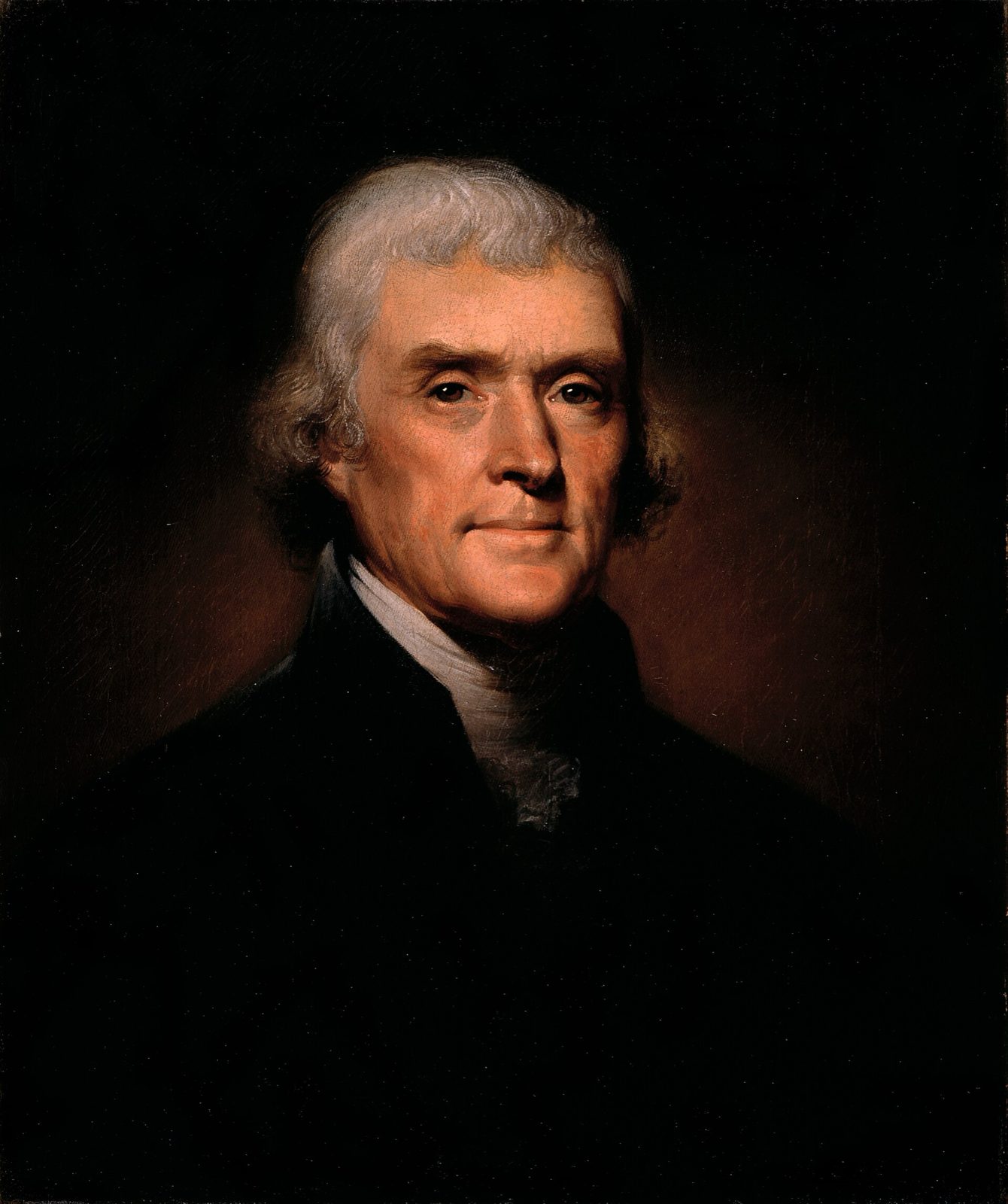
Head-and-shoulders portrait of Thomas Jefferson with gray hair brushed back from his forehead, looking directly at the viewer with a faint smile. He wears a dark coat with a high collar and a white neckcloth against a dark brown background.
Thomas Jefferson
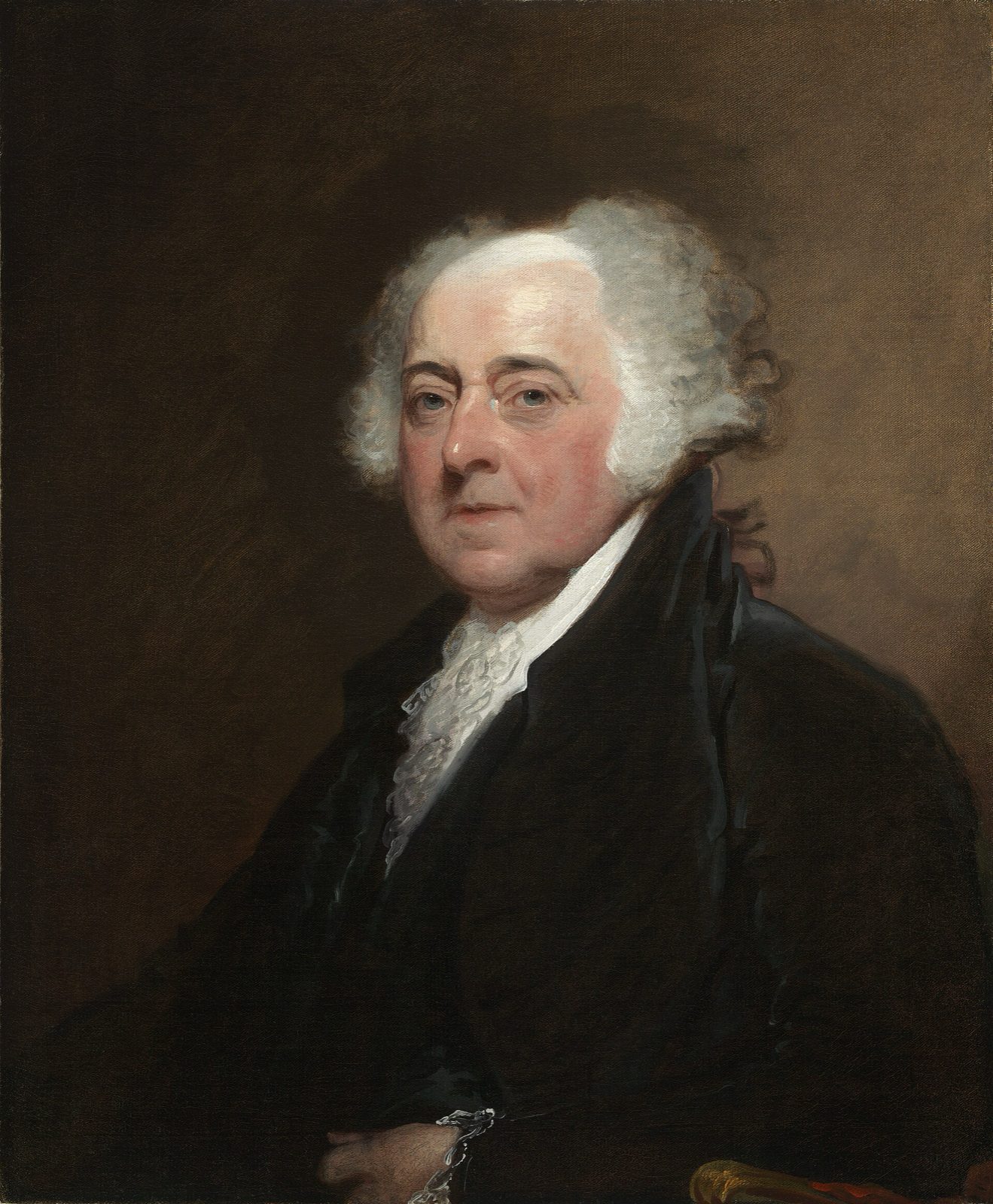
An elderly John Adams, seated and turned three-quarters to the left, looks steadily at the viewer, his thinning white hair curling over his ears. He wears a black coat and a white lace neckcloth against a plain brown background, with the gilt arm of a chair at lower right.
John Adams
Read the lettersThe story in five actsSources and method

Every surviving letter, with the original transcription, research notes and a plain modern rendering side by side.

§What is this edition?

The Jefferson–Adams Letters is a reading edition of the 335 surviving letters that John Adams and Thomas Jefferson wrote to each other between 1777 and 1826. Each letter has three layers: the original transcription from Founders Online, short research notes on the people, events and old words a modern reader would miss, and a clear modern English rendering that keeps every idea and each man’s voice.

Every letter now has its modern text and notes. How the edition is made.

01How large is the correspondence?
Letters
335
From John Adams
189
From Thomas Jefferson
146
1777 to 1826
50 yrs

191,851 words in all · 159 of the letters written from 1812 on

02The Story

Fifty years, in five acts.

Two revolutionaries became diplomats, then rivals, then strangers, then the closest of correspondents. Their letters follow the arc of the friendship and of the country they made.

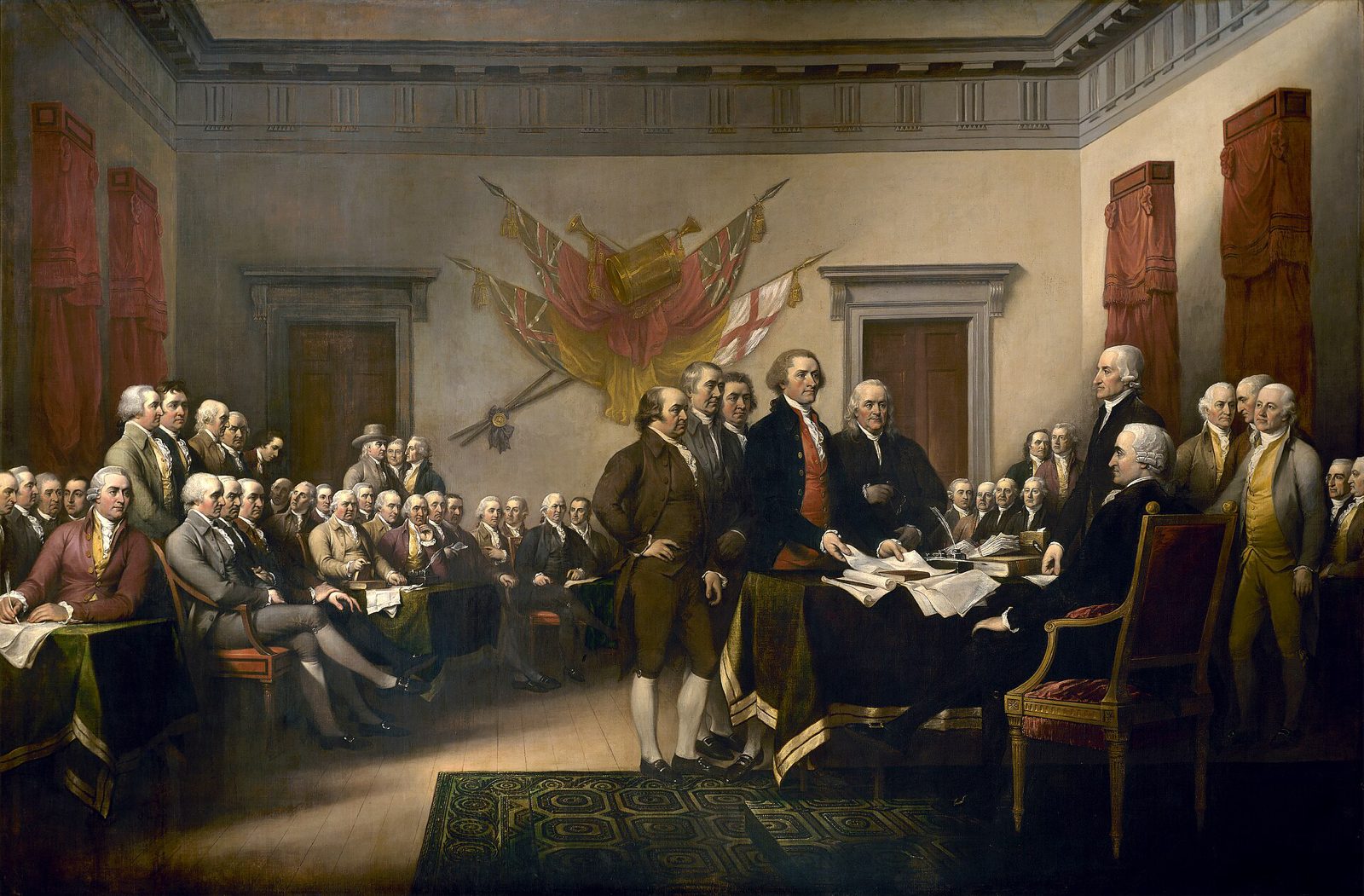
In a high-ceilinged chamber, the five men of the drafting committee stand before a draped table and present their document to John Hancock, seated at right; Thomas Jefferson, tall at the center, lays the papers down, and John Adams stands at the left of the group with a hand on his hip. Dozens of delegates watch from chairs and standing groups beneath captured flags and a drum hung on the back wall.

Act I · Philadelphia, 1776

Declaration of Independence · John Trumbull, 1819
I1777–1784 · 8 letters

The Revolution

They met in the Continental Congress at Philadelphia. In June 1776 both sat on the committee of five that prepared the Declaration of Independence. Jefferson wrote the draft, and Adams was its strongest champion in the debate.

The correspondence opens in May 1777. Jefferson, back in Virginia, asks Adams in Congress to help settle how large and small states should share power under the Articles of Confederation. Then Adams sailed for France and Jefferson became governor of Virginia, and only a handful of letters survive from these years.

In 1784 Congress sent Jefferson to Paris to join Adams and Benjamin Franklin in negotiating treaties of commerce.

II1784–1789 · 140 letters

Ministers in Europe

Jefferson reached Paris in August 1784, and the Adams family settled at Auteuil, just outside the city. Jefferson became a frequent guest and a friend of the whole family.

In 1785 Adams moved to London as the first American minister to Great Britain, and Jefferson succeeded Franklin as minister to France. Their letters became the working channel of American diplomacy in Europe: treaties with Prussia and Morocco, ransom for American sailors held in Algiers, public debts, tobacco and whale oil.

In the spring of 1786 Jefferson spent seven weeks in London, and the two men toured English country gardens together. In 1787 they compared their first thoughts on the new Constitution, and in March 1788 they met in the Netherlands to raise a loan from Dutch bankers. Adams sailed home in 1788, Jefferson in 1789.

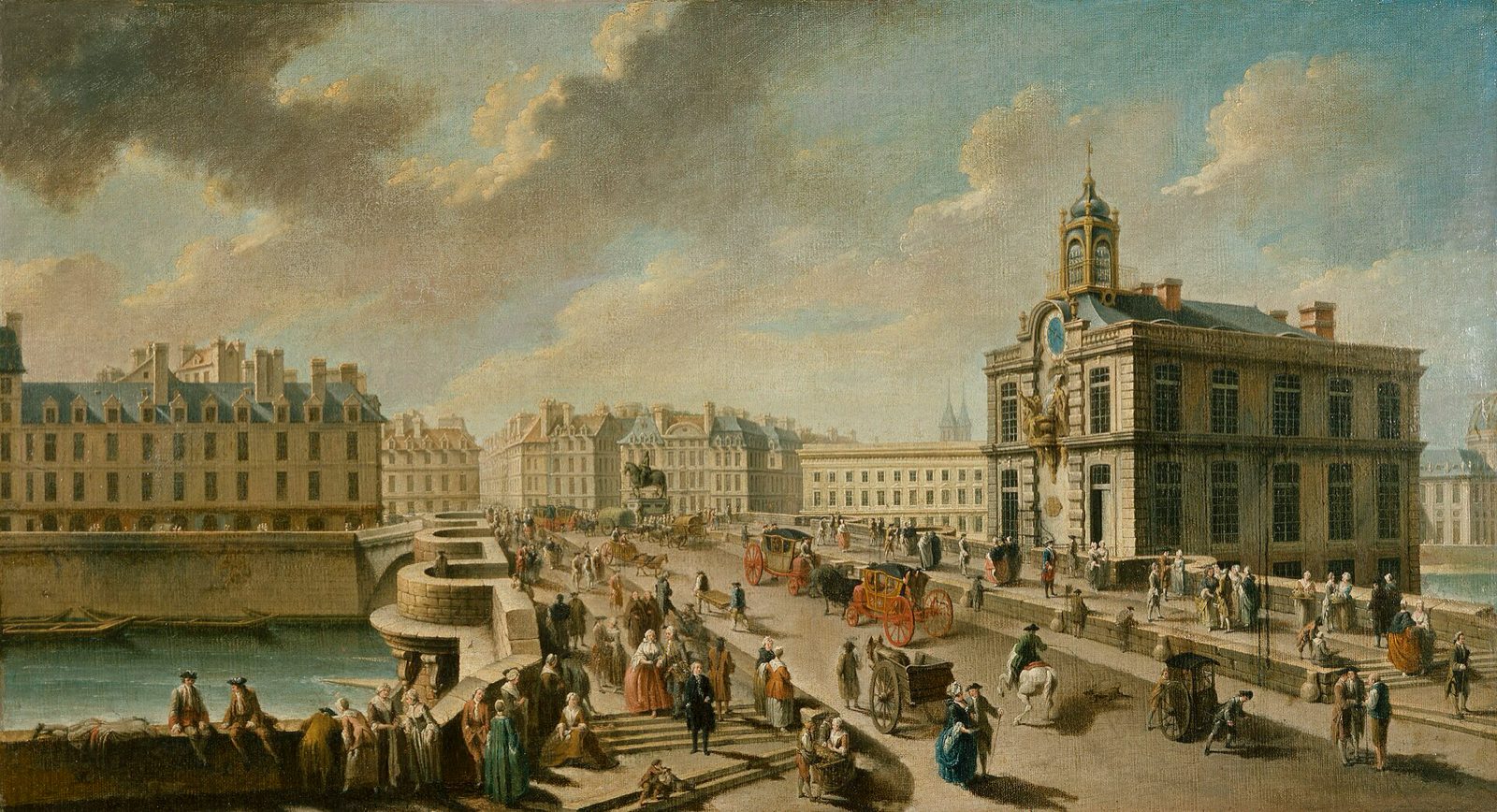
A busy Pont Neuf in Paris on a bright day, crowded with carriages, a horseman, porters and strolling men and women. At right stands the Samaritaine pump house with a clock, gilded sculpture and a small domed bell tower; the equestrian statue of Henri IV rises in the middle distance, and the houses of the Île de la Cité line the river at left.
The Pont Neuf, ParisNicolas-Jean-Baptiste Raguenet, 1777
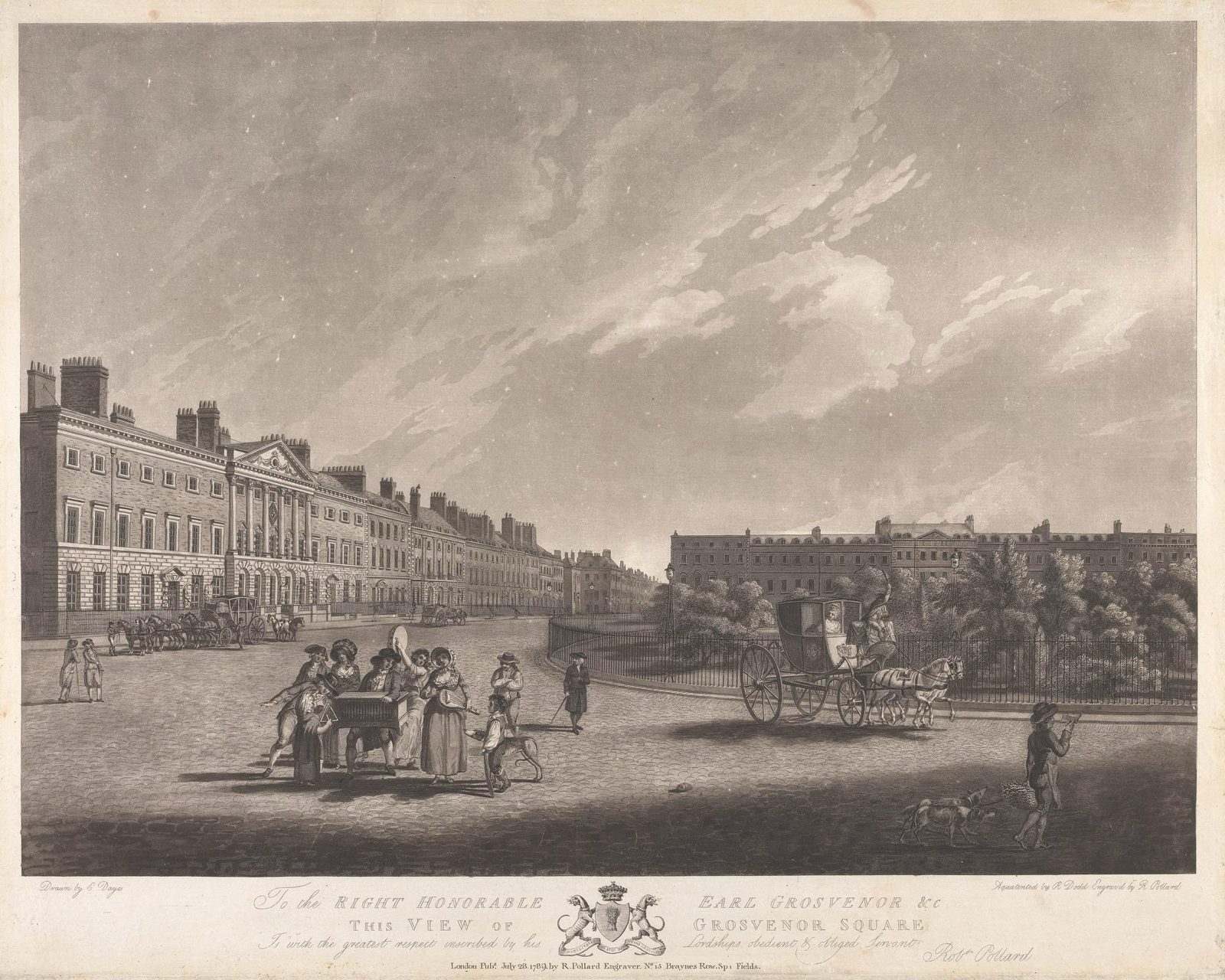
A sepia print of Grosvenor Square in London: a long row of grand brick-and-stone townhouses runs down the left side, and at right a two-horse carriage passes the railed, tree-filled garden in the middle of the square. In the foreground, street musicians with a barrel organ, a hurdy-gurdy, a tambourine and a triangle draw a boy and his dog, while a man with two more dogs walks past.
Grosvenor Square, LondonAfter Edward Dayes, 1789
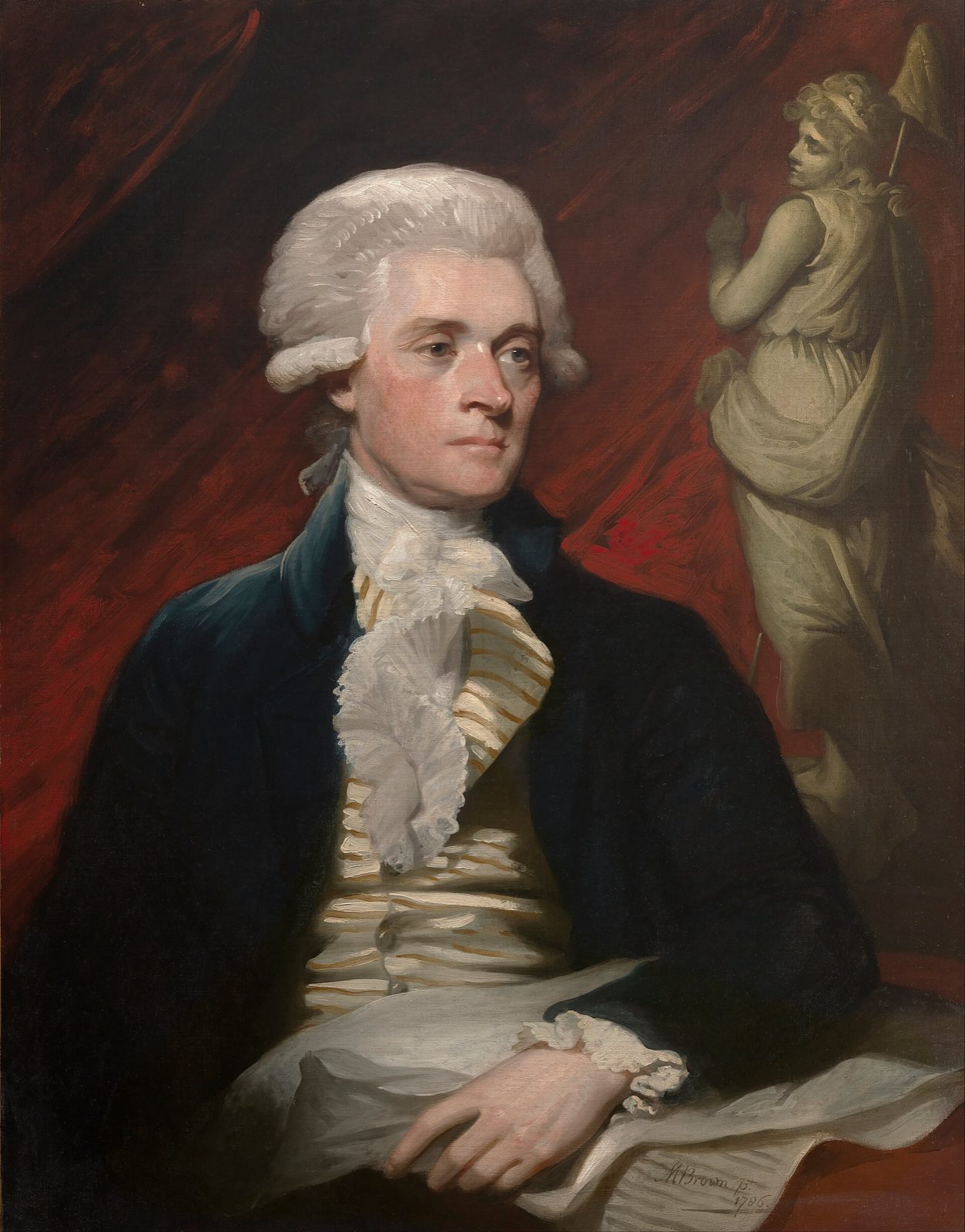
Half-length portrait of Thomas Jefferson in a powdered wig, seated before a deep red curtain in a dark blue coat, a striped cream-and-gold waistcoat and a lace neckcloth, one hand resting on a sheet of papers. Behind him at right stands a pale statue of a robed woman holding a tall staff.
Thomas JeffersonMather Brown, 1786
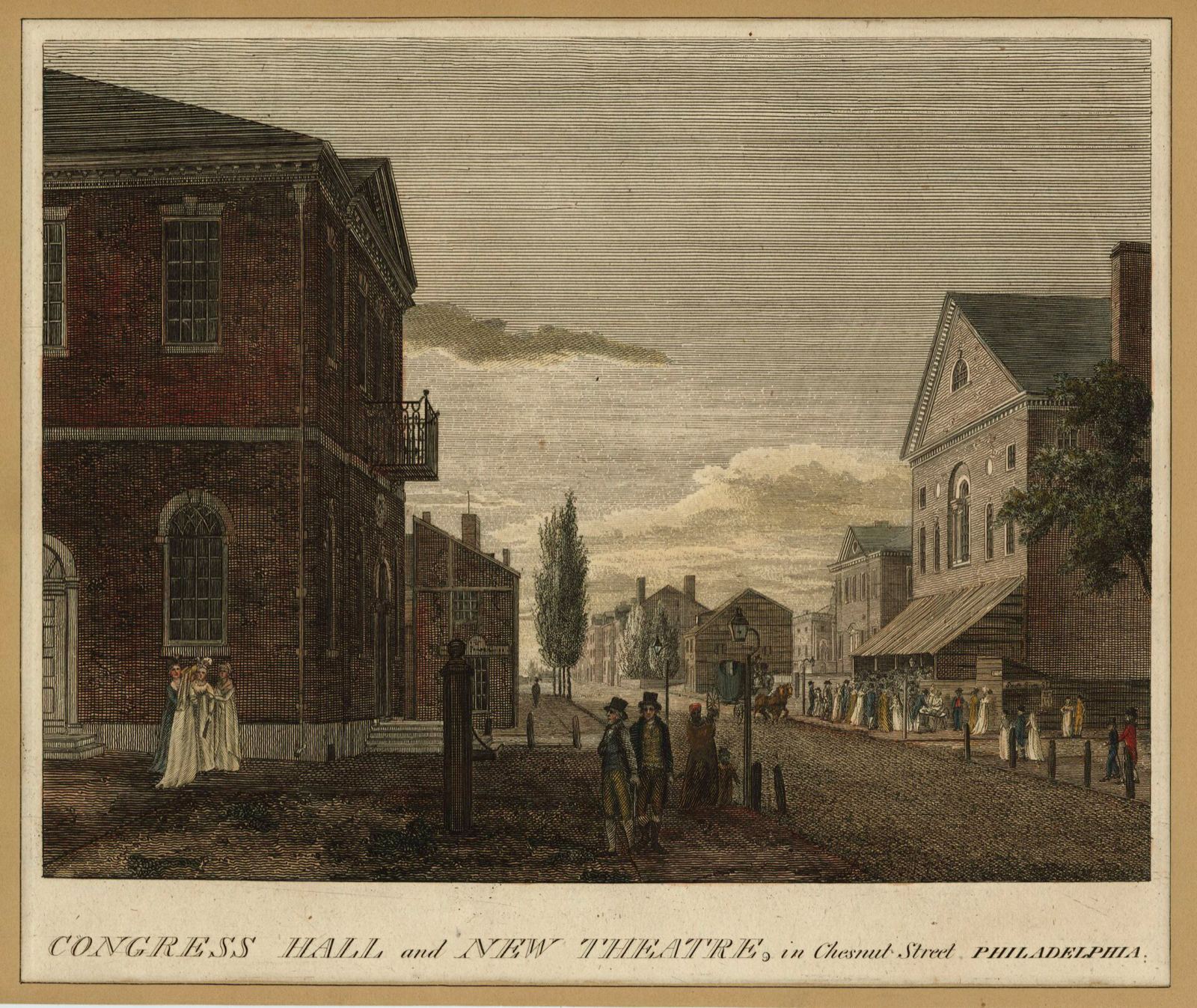
A hand-colored engraving of Chestnut Street in Philadelphia: the red-brick Congress Hall, with a tall arched window and an iron balcony, fills the left side, and across the cobbled street at right stands the pale, gabled New Theatre with an awning and a crowd at its doors. Women in white dresses walk beside Congress Hall, and two men in top hats talk near a street pump in the foreground.
Congress Hall, PhiladelphiaWilliam Russell Birch, 1800
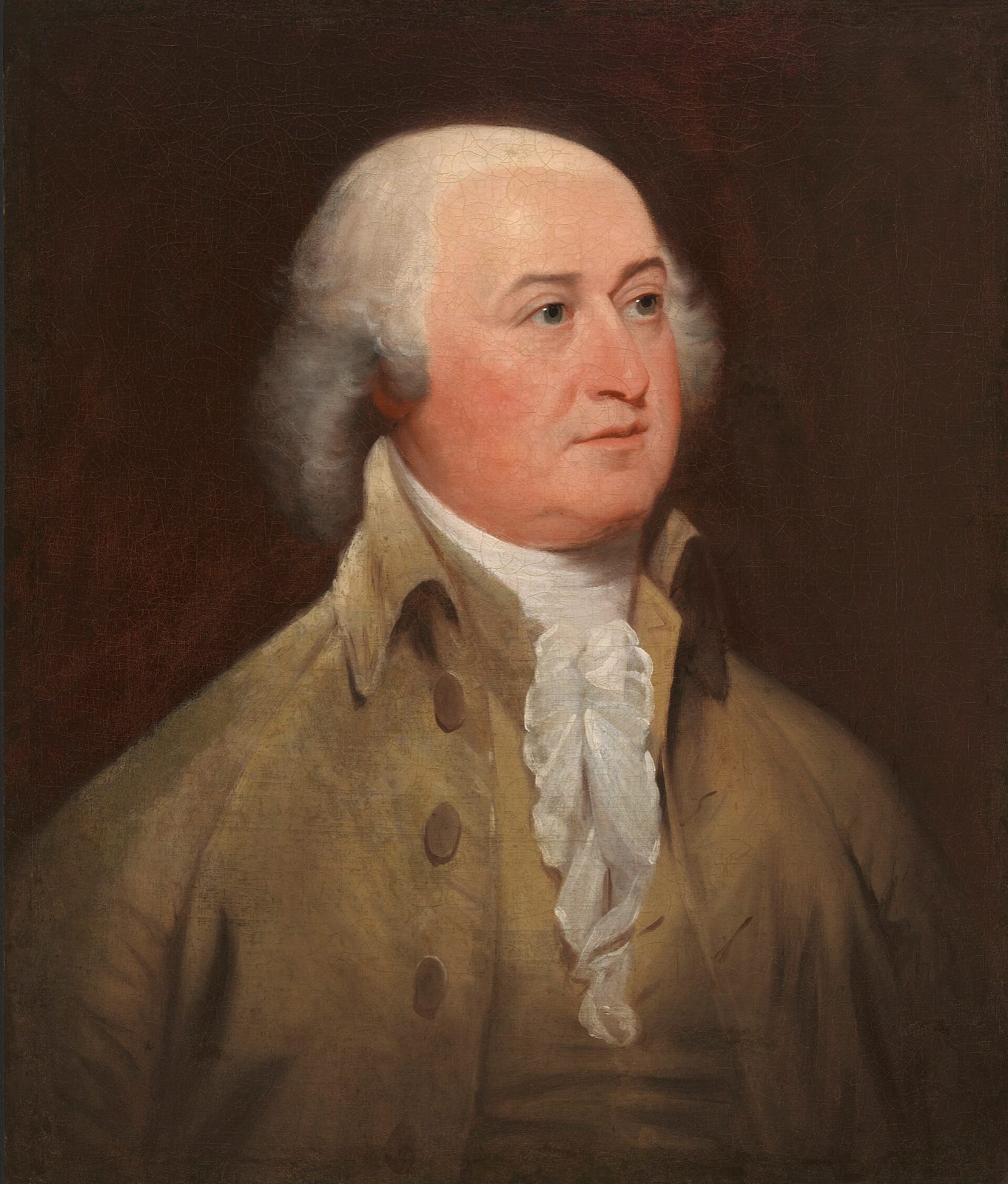
Head-and-shoulders portrait of John Adams with powdered white hair, turned to the right and gazing past the viewer. He wears an olive-brown coat with large buttons and a ruffled white neckcloth against a dark reddish-brown background, and fine cracks show in the old paint.
John AdamsJohn Trumbull, 1793
III1789–1801 · 28 letters

The New Republic

Adams became the first Vice President and Jefferson the first Secretary of State. Now they lived in the same city, first New York and then Philadelphia, so they wrote less. They also disagreed more: about the French Revolution, about titles and rank, and about how strong the new government should be.

In 1791 a printer used a private note of Jefferson’s to introduce Thomas Paine’s Rights of Man, and readers took it as an attack on Adams. Jefferson wrote to explain, and Adams accepted his word. But the two men now stood on opposite sides of a widening party divide.

In 1796 Adams defeated Jefferson for the presidency, and Jefferson became his Vice President. In 1800 Jefferson defeated Adams. Adams’s last letter of the period, in March 1801, speaks of the death of his son Charles.

IV1801–1811 · no letters

The Long Silence

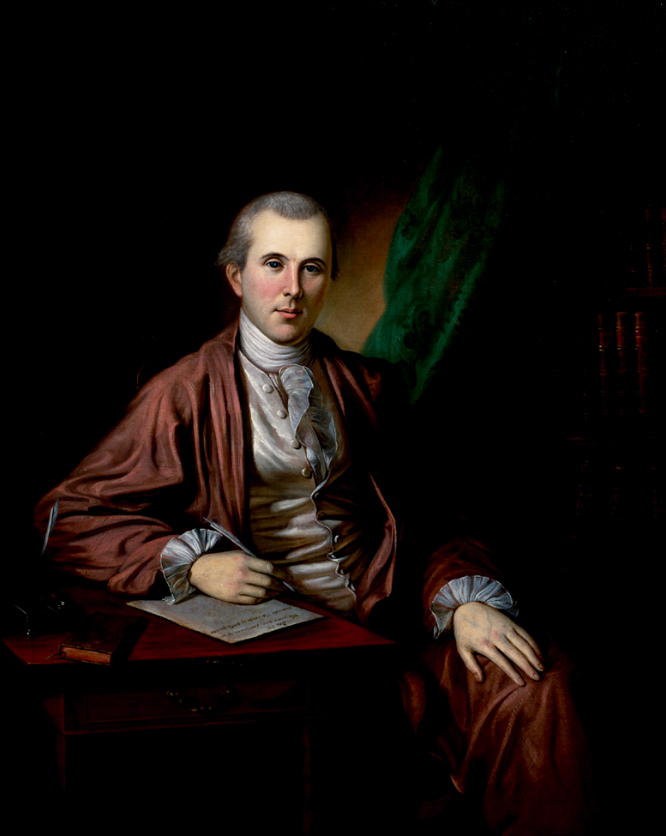
Benjamin Rush sits at a small desk with a quill in his right hand and a written page before him, his left hand resting on his knee. He wears a loose reddish-brown gown over a cream waistcoat and a white neckcloth, against a dark background with a green curtain and shelves of books.
Benjamin RushCharles Willson Peale, 1783

After the bitter election of 1800 the two men did not write to each other for almost eleven years.

The election of 1800 was a bitter contest, and Jefferson won it. In his last weeks in office Adams filled new judgeships and other posts with Federalists, appointments that Jefferson took as a personal unkindness. On March 4, 1801, the day Jefferson took office, Adams left Washington before dawn.

No letter passed between them for almost eleven years. In 1804, after the death of Jefferson’s daughter Mary, Abigail Adams wrote to him in sympathy. Their short exchange turned to old grievances, and she ended it. Those letters are hers, and they are not part of this edition.

Their friend Benjamin Rush, the Philadelphia physician who had signed the Declaration with them, worked for years to bring them back together. In 1811 a visitor to Quincy reported Adams saying that he had always loved Jefferson and loved him still. Jefferson heard of it. On New Year’s Day 1812, Adams wrote first.

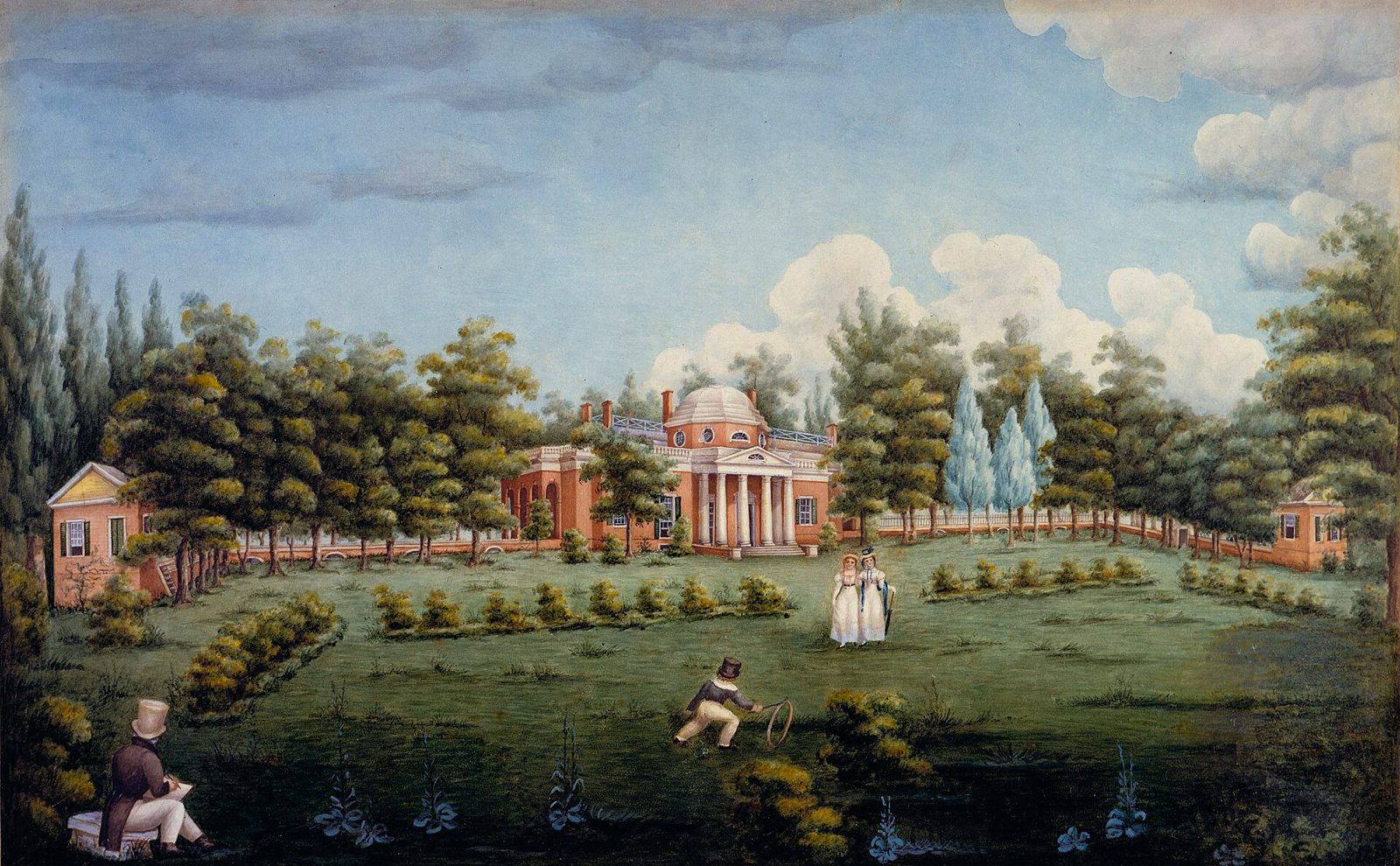
A watercolor of Monticello's west front: a red-brick house with a white-columned portico and a low dome stands behind a broad lawn ringed by trees, flowering shrubs and two small outbuildings. Two girls in white dresses walk arm in arm, a boy in a top hat chases a hoop, and a man in a top hat sits sketching in the lower left corner.

Jefferson’s Monticello

Monticello, the west front · Jane Braddick Peticolas, 1825
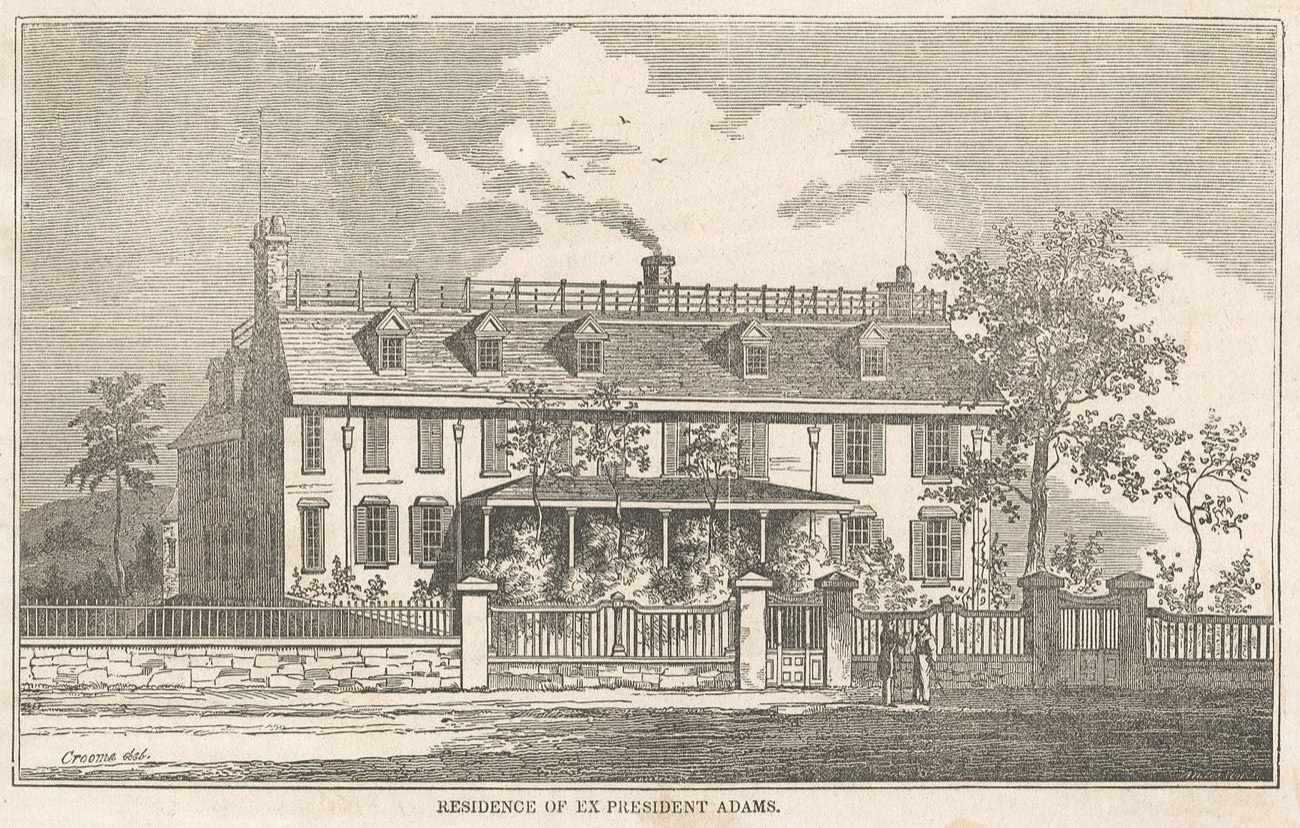
A black-and-white wood engraving of a long two-story house with shuttered windows, five roof dormers, tall chimneys and a railed walk along the roof, its front porch covered in vines. A stone wall and picket fence with square gateposts run along the road, where two men stand talking. The caption below reads “Residence of Ex President Adams.”

The Adams house at Quincy

The Adams house, Quincy · After William Croome, 1830
V1812–1826 · 159 letters

The Reconciliation

Adams opened with a short note about two pieces of homespun. It was a joke: the package held his son John Quincy Adams’s lectures on rhetoric. Jefferson answered at length, and the old partnership resumed as a conversation.

For fourteen years they argued with each other and consoled each other by post. They wrote about a natural aristocracy of virtue and talent, the uses of grief, whether they would live their lives again, the death of Abigail Adams in 1818, and Jefferson’s new University of Virginia.

Jefferson’s last letter, in March 1826, introduced his grandson Thomas Jefferson Randolph, and Adams answered it in April. Both men died on July 4, 1826, fifty years to the day after the adoption of the Declaration of Independence: Jefferson at Monticello shortly after noon, and Adams at Quincy that evening, not knowing that his friend had died a few hours before.
03How to read it

Three layers for every letter.

Read the modern text for ease, the original for exactness, or both side by side on a wide screen.

01

The original

The verbatim transcription published on Founders Online, with each writer’s spelling, capitals, underlining and crossings-out kept as the editors printed them. Every letter links its source page and the archived copy we read.

02

The notes

Short research notes on what a modern reader would miss: people, events, books, places, money and words that have changed their meaning. Each note is written in our own words and lists its sources.

03

The modern text

A plain modern English rendering that keeps every idea, adds nothing, and keeps Adams sounding like Adams and Jefferson like Jefferson. The original is always one click away.